
FREQUENTLY ASKED QUESTIONS
Where is the project?
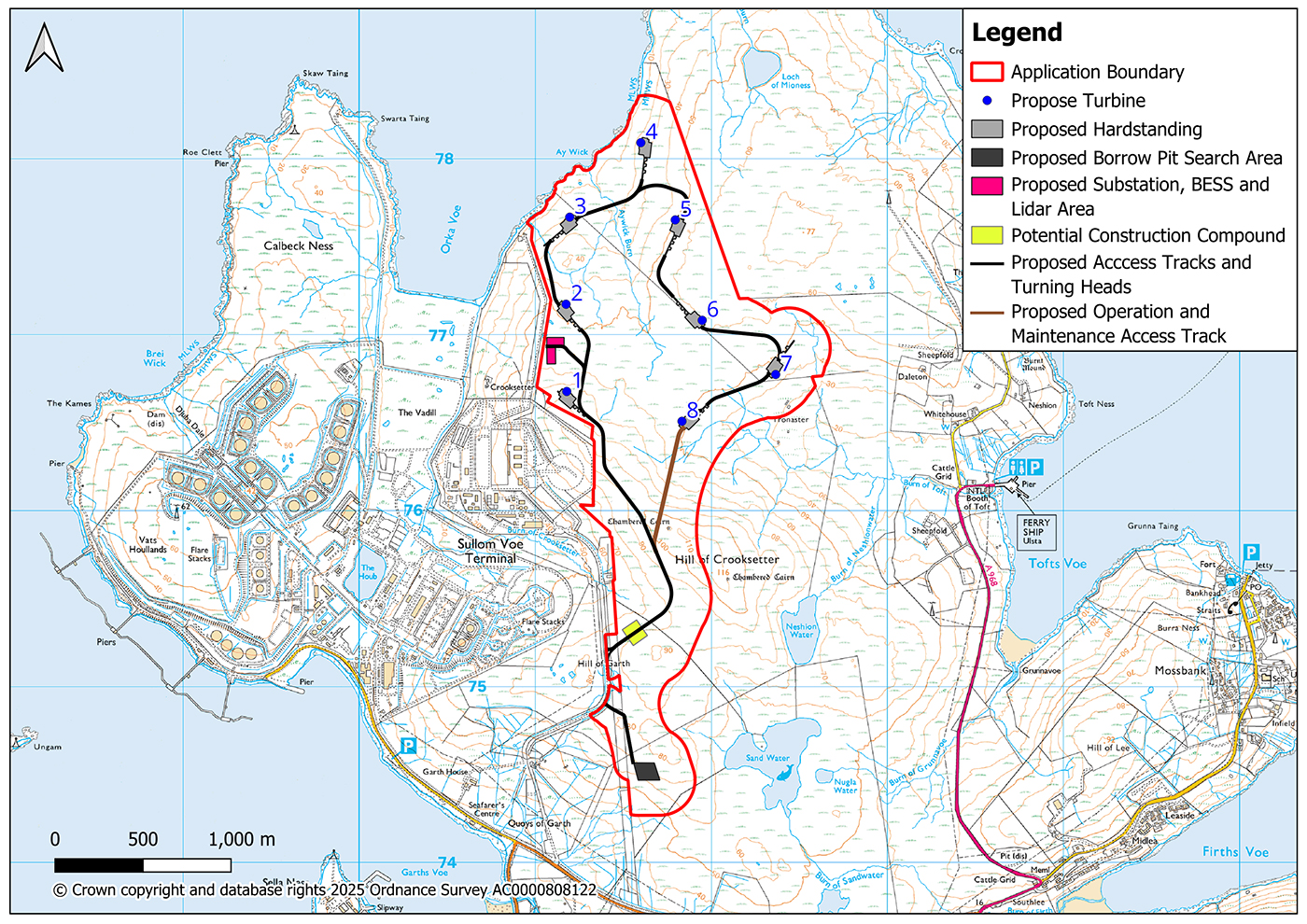
Neshion Energy Park (NEP) is located adjacent to Sullom Voe Oil Terminal and the Shetland Gas Plant in the North Mainland of Shetland, Scotland.
Why is this project needed?
This project will contribute to Scotland’s and Shetland’s climate change, energy security, and Just Transition objectives.
We are in a Climate Emergency. This means that we need to transition away from fossil fuels as quickly as possible and replace them with clean energy alternatives. The Scottish and UK Governments have set ambitious targets around both onshore wind energy and clean power. These targets will require the rapid construction of renewable energy projects across the country, including both low-carbon generation and energy storage.
Recent geopolitical events have shown that renewable energy projects are a solution to improving our nation’s energy security.
Our project could provide renewable generation supporting potential low-carbon fuel production at SVT, including hydrogen and e-fuels, and contribute to the reuse of existing infrastructure and skills in a new energy system. An early shift to low-carbon fuel production could help underpin a successful transition for SVT.
What are the real local benefits for people living nearby?
Neshion Energy Park has the potential to deliver a range of local benefits, including employment opportunities, support for local businesses, investment in skills development and long-term economic activity.
The project is being developed with the aim of ensuring local communities share in the benefits of the transition to a lower-carbon energy system. Alongside a Local Electricity Discount Scheme, the proposed development also proposes community ownership options, ongoing engagement through a dedicated Community Liaison Officer role, and the potential to direct a share of long-term value into locally determined priorities.
What is the Local Electricity Discount Scheme?
The proposed LEDS scheme has been designed to provide direct benefits to residents and businesses located closest to NEP. Properties within the proposed LEDS zone including Toft, Brough, Mossbank, Firth, and Graven postcode areas, would be eligible for a discount on their electricity bills, subject to the scheme’s final terms and conditions.
I don’t have electric heating, will I still benefit from the LEDS?
All eligible addresses in the LEDS postcode areas will be able to apply for the scheme, regardless of what fuel is used for heating in any property. The LEDS can support the cost of standing charges and electricity used for lighting and other consumption.
Further information on the LEDS scheme will be provided as the project progresses.
Will there be a community benefit fund?
The traditional pot of money allocated for a community benefit fund is still budgeted but the majority of this will be used to fund the LEDS. There will still be sums available for further investment in community initiatives such as support for environmental protection and energy literacy.
Will local contractors and suppliers be used?
Yes, Neshion Energy Park is committed to maximising opportunities for local businesses, contractors and suppliers wherever possible. The project has the potential to support employment, skills development and economic investment within Shetland throughout the construction and operational phases.
Has a Planning Application been submitted?
Yes. A Planning Application has been submitted to the Scottish Government’s Energy Consents Unit (ECU).
Where can I view the Planning Application?
The Planning Application and all supporting documents are available to view on the ECU and NEP website. A link to the application can be found here.
How can I comment on the application?
Anyone can submit comments on the Planning Application directly to the ECU. Details on how to make a representation are available on the ECU website and within the application documentation.
Who will decide whether the project is approved?
As the proposed development will generate more than 50 megawatts of electricity, Scottish Ministers will make the final decision.
The Scottish Government’s Energy Consents Unit (ECU) consults with a range of stakeholders such as statutory agencies, local and community councils and members of the public in order to make recommendations to Ministers. Shetland Islands Council (SIC) is included in this consultation process.
How have the impacts of the project been assessed?
The planning application is supported by an Environmental Impact Assessment Report (EIAR), which has been prepared by a team of specialist environmental and technical consultants. The EIAR is available here.
The EIAR assesses the likely significant effects of the proposed development on topics including landscape and visual impact, ecology, ornithology, cultural heritage, traffic and transport, noise, hydrology and peat, among others. The assessment also identifies measures to avoid, reduce or manage potential impacts.
Additional supporting information has been submitted covering topics such as socio-economics and carbon balance.
What happens if the project is consented?
If the project is consented, there are various steps before construction can begin. We expect there to be certain conditions on the consent that would need to be discharged through the SIC planning process. There would also be consideration for the final investment decision which would include the mechanisms for community benefit package, budgeting for peatland restoration and habitat management, and accounting for community ownership stakes.
Why was the site selected for the proposed development?
The site is situated adjacent to one of Europe’s largest oil terminals. The site boasts exceptional wind resources, making it an ideal location for a renewable energy park dedicated to generating clean, sustainable energy.
How much of the site will be developed?
The application site covers approximately 300 hectares. Not all of this area will be developed. The site boundary provides flexibility for infrastructure placement, environmental mitigation, habitat enhancement and access arrangements.tion Management Plan will be produced as part of the planning application, outlining how construction activities will be managed. This plan will be agreed upon with the relevant authorities before any work begins on site, subject to planning approval.
How long will construction take?
The construction period will take approximately 2 years. An outline Construction Management Plan will be produced as part of the planning application, outlining how construction activities will be managed. This plan will be agreed upon with the relevant authorities before any work begins on site, subject to planning approval.
Are there any hazards or risks associated with the development?
Risks during construction will be managed with robust health and safety practices, in line with industry standards. During operation, systems and processes will be in place to ensure everyone working at or visiting the site is as safe as possible. The developer has created an outline Battery Safety Statement for the BESS element, and this will continue to be refined with the relevant authorities as plans progress.
What happens at the end of the project’s operational life?
The operational lifetime of the project is 40 years. Onshore wind technology has been evolving rapidly over the past few decades and is expected to do so again before the end of our project’s lifetime. There are 3 options at the end of the 40 years:
- Extension of operational life – maintaining and refurbishing the existing turbines to increase their operational life.
- Repowering – upgrading and/or replacing turbines and infrastructure with newer and more efficient ones.
- Decommissioning – deconstruction of the turbine, tracks, and infrastructure across the site with the ambition to reuse or recycle as much as possible. The energy industry is currently exploring the most efficient options for reusing and recycling more complex components such as composite blades and steel towers.